
Multiway Causality Visual Model
Two graphs side by side. One is deterministic but breaks relativity. The other preserves relativity but isn't deterministic. Both are verified in Lean 4—what you see is the proof, rendered in 3D.
Lean Counterexamples
Wolfram Spatial Hypergraph
What You're Seeing
This visualization shows two counterexample systems from Piskunov's 2020 paper, formalized in Lean. They prove that confluence (determinism) and causal invariance (relativity) are logically independent properties.
{{x,y,z},{u,y,v}} → {{w,z,x},{z,w,u},{x,y,w}}, the same idea Stephen Wolfram describes for the atoms of space.The Core Insight
Physics assumes determinism and relativistic agreement go together. These counterexamples show they don't. The Lean proofs make this machine-verifiable.
Proof Artifacts
Causal Confluence Lean repositoryOriginal Work
Piskunov: Confluence and Causal InvarianceDeep Dive
Full research project pageUnderstanding the Two Properties
Confluence
Think: Computing 2+3 vs 3+2. Different order, same answer.
Formally: All paths through the multiway graph reach the same final state. The system is deterministic regardless of evaluation order.
Causal Invariance
Think: Einstein's relativity. Different observers, same causal structure.
Formally: The causal graph (what caused what) is isomorphic across all evaluation orders. Observers agree on causation.
Reading the Visualization
The Animation Cycle
The visualization alternates focus between CE1 and CE2. When a graph is active, it pulses slightly and becomes fully opaque. The inactive graph fades to 25% opacity.
The Stats Panel
Bottom right shows the active graph's metrics: node count, edge count, branchial links, and depth. "Divergent links" counts branchial pairs that differ between CE1 and CE2.
The Legend
Bottom left explains the visual elements: causal edges (evolution paths), divergent branchials (highlighted in red), and causal cones (showing the "light cone" structure).
Why This Matters
For the Wolfram Physics Program
Wolfram conjectured that a "theory of everything" must have causal invariance. This research shows that achieving causal invariance is a separate challenge from achieving determinism—both must be addressed independently in any fundamental theory.
For Scientific Visualization
This model demonstrates a new paradigm: visualizations driven by formally verified proofs. The node positions, edge connections, and graph structures all come from data exported by Lean. What you see is mathematically certified.
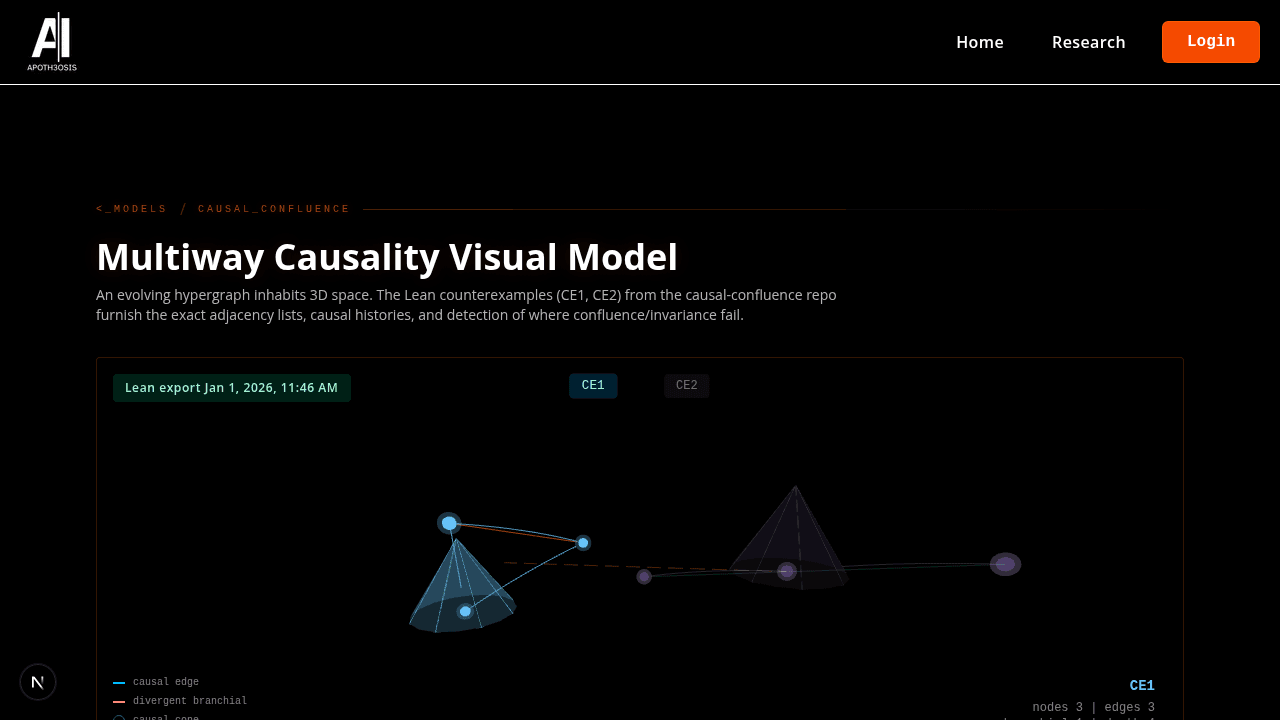
CE1 and CE2 from Lean
Both counterexample graphs rendered side-by-side from verified proof data.
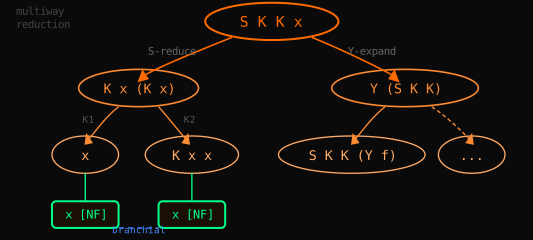
Multiway topology
Reference diagram showing how branching paths create the multiway structure.
This model runs in your browser using WebGL. The graph data is loaded from JSON files exported by the Lean proof build. For enhanced versions with larger graphs and audio, contact IAOM@apoth3osis.io.